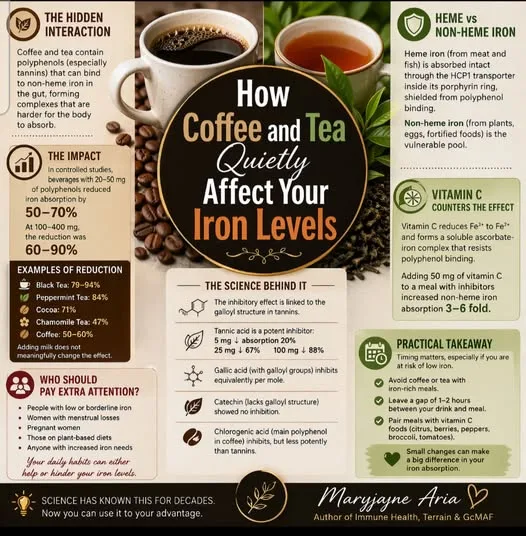
Coffee and tea are often praised for their antioxidant content, but there is a lesser known interaction that matters for some people. Both beverages contain compounds called polyphenols that can reduce the absorption of non heme iron in the gut.
Non heme iron is the form found in plant foods, eggs, and many fortified products. It is more sensitive to dietary factors than heme iron, which is found in meat and fish and is absorbed more efficiently.
The interaction between polyphenols and iron has been studied for decades. Research led by Richard F. Hurrell in 1999 demonstrated that drinking tea or coffee with a meal can significantly reduce non heme iron absorption. In controlled settings, reductions of 50 percent or more were observed when beverages rich in polyphenols were consumed alongside a standardized meal.
Tea appears to have one of the strongest effects due to its high tannin content. Coffee also reduces absorption, though typically to a slightly lesser extent. Herbal teas vary depending on their composition, with some having a moderate effect and others less pronounced.
The mechanism behind this is relatively straightforward. Polyphenols can bind to iron in the digestive tract, forming complexes that are more difficult for the body to absorb. This does not mean that all iron is blocked, but it can significantly reduce the amount that enters circulation, particularly when meals rely heavily on non heme iron sources.
Earlier work by Lars Hallberg and M. Brune explored how specific compounds, especially tannins, influence this process. They found that the inhibitory effect depends on the chemical structure of the polyphenols, with certain forms being more potent than others. However, in real diets, foods and beverages contain a mixture of compounds, so the overall effect is influenced by the full meal context.
Heme iron behaves differently. It is absorbed through a separate pathway that protects it from many dietary inhibitors, including polyphenols. This is one reason why iron from animal foods is generally more bioavailable than iron from plant sources.
Vitamin C plays an important counter role. It can enhance the absorption of non heme iron by converting it into a more absorbable form and helping keep it soluble in the gut. Research by Lars Hallberg and Anette Hulthén showed that adding vitamin C to a meal can significantly improve iron uptake, even in the presence of inhibitors.
In everyday life, the impact of coffee and tea depends on the overall diet and individual iron status. For people with adequate iron levels, drinking these beverages with meals is unlikely to cause a major issue. The body can adapt to some extent, and mixed diets often contain both inhibitors and enhancers.
However, for those at higher risk of iron deficiency, the timing of these drinks can make a meaningful difference. This includes individuals who follow plant based diets, women with regular menstrual losses, and those with increased iron needs such as during pregnancy.
A simple approach is to avoid drinking coffee or tea with iron rich meals and instead leave a gap of one to two hours. Pairing meals with foods high in vitamin C, such as citrus fruits or peppers, can further support iron absorption.
In summary, the science behind this interaction is well established. Coffee and tea can reduce non heme iron absorption, sometimes quite significantly under controlled conditions. At the same time, the effect is not absolute and can be managed through simple dietary strategies. Understanding the balance between inhibitors and enhancers is the key to maintaining healthy iron levels while still enjoying these widely consumed beverages.
Sources
Hurrell RF et al. The influence of tea and coffee on iron absorption. British Journal of Nutrition, 1999
Brune M, Rossander L, Hallberg L. Iron absorption and phenolic compounds. European Journal of Clinical Nutrition, 1989
Hallberg L, Hulthén L. Prediction of dietary iron absorption. American Journal of Clinical Nutrition, 2000
Written by Maryjayne Aria
Author of Immune Health, Terrain & GcMAF