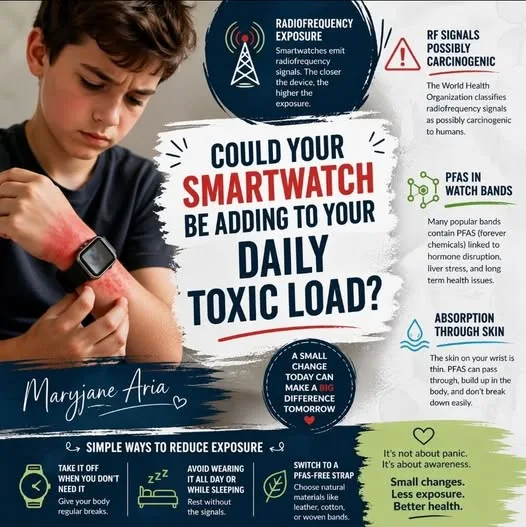
You probably wear your smartwatch every day. Most people do. It tracks your steps, your sleep, your heart rate. It has quietly become part of your routine, almost like a second skin.
But that is exactly where the conversation begins.
A smartwatch is not just a passive accessory. It sits tightly against your skin for hours at a time. While it is on, it communicates constantly, sending and receiving radiofrequency signals to stay connected. These signals fall within the category of electromagnetic fields that have been classified by the World Health Organization as possibly carcinogenic to humans. That classification does not mean harm is guaranteed, but it does raise a valid question about long term, close range exposure.
Distance matters more than most people realise. The closer a device is to your body, the more direct the exposure. Unlike a phone that you pick up and put down, a smartwatch maintains continuous contact with the skin. Day after day, hour after hour.
Then there is the strap, which is often overlooked.
Recent testing has revealed that many popular smartwatch bands contain PFAS, a group of synthetic chemicals commonly referred to as forever chemicals. These substances are used to make materials resistant to water, sweat, and oils. On the surface, that sounds practical. Underneath, it is more concerning.
PFAS have been linked in research to hormone disruption, liver strain, immune effects, and long term accumulation within the body. What makes them particularly troubling is their persistence. They do not break down easily, either in the environment or inside the human body.
Now consider where that strap sits.
The skin on your wrist is relatively thin and highly absorbent. It is also an area exposed to warmth, sweat, and friction, all of which can increase the potential for substances to pass through the skin barrier. Over time, even low level exposure can contribute to overall body burden.
This is not about fear. It is about informed awareness.
Technology brings benefits, but it also brings new forms of exposure that did not exist a generation ago. The goal is not to reject it entirely, but to use it more consciously.
There are simple ways to reduce unnecessary exposure without giving up the convenience:
Take the watch off when you do not need it, especially during periods of rest or when you are at home.
Avoid wearing it while sleeping, giving your body a break from continuous contact and signals.
Consider switching to a strap made from natural materials that are less likely to contain synthetic chemical treatments.
Small adjustments like these may seem insignificant in isolation. But health is rarely shaped by one single factor. It is the accumulation of daily habits, repeated over time, that creates either resilience or strain.
Your environment does not begin outside of you. It begins at the surface of your skin.
Written by Maryjayne Aria
Author of Immune Health, Terrain & GcMAF