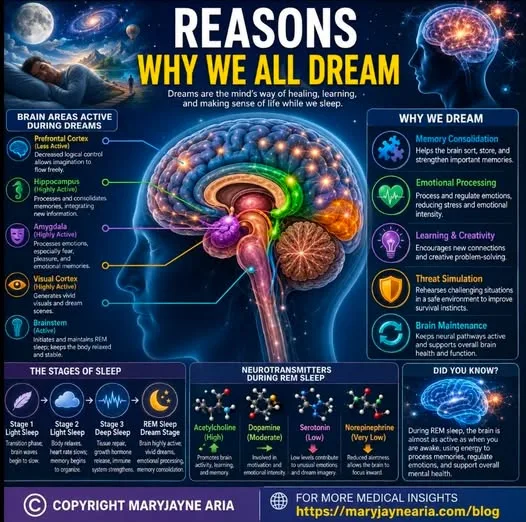
Every night, as we drift into sleep, our brains embark on one of the most fascinating journeys in human biology. Dreams can be joyful, terrifying, confusing, inspiring, or completely bizarre. Although scientists have studied dreaming for decades, there is still no single explanation that fully answers why we dream. What researchers do know is that dreaming is closely linked to memory, emotional health, brain development, learning, and neurological function.
Dreams are far more than random images. They are the product of a remarkably active brain that continues working while the body rests.
What Is a Dream?
A dream is a series of thoughts, images, emotions, sensations, and experiences that occur during sleep. Most vivid dreams occur during Rapid Eye Movement (REM) sleep, although dreaming can also happen during non-REM stages.
During REM sleep:
• The brain becomes almost as active as it is during wakefulness. • The eyes move rapidly beneath closed eyelids. • Most skeletal muscles become temporarily paralyzed to prevent acting out dreams. • Heart rate and breathing become more variable. • The brain processes enormous amounts of stored information.
An average adult experiences four to six REM cycles every night, with REM periods becoming progressively longer toward morning. Most people dream for approximately two hours every night, even if they remember none of it.
The Four Stages of Sleep
Sleep is divided into two major categories:
Non-REM Sleep
This includes three stages.
Stage 1: A light sleep where brain waves begin slowing. This transition lasts only a few minutes.
Stage 2: Body temperature falls, heart rate slows, and the brain begins organizing memories. This stage accounts for nearly half of total sleep.
Stage 3: Known as deep sleep or slow-wave sleep. Tissue repair occurs, growth hormone is released, immune function is strengthened, and physical recovery takes place.
REM Sleep
REM usually begins about 90 minutes after falling asleep.
During REM:
• Brain activity rises dramatically. • Dreams become vivid and emotional. • Memory processing accelerates. • Emotional regulation occurs. • Creativity often flourishes.
Which Parts of the Brain Are Active?
Modern brain imaging has revealed that several regions become especially active during dreaming.
Hippocampus
The hippocampus is essential for forming and organizing memories. During REM sleep it helps transfer short-term memories into long-term storage while connecting new information with existing knowledge.
Amygdala
The amygdala processes fear, pleasure, anxiety, and emotional significance.
Its high activity explains why dreams often contain intense emotions even when the storyline makes little logical sense.
Visual Cortex
The visual cortex creates the detailed scenery, faces, colors, and movement experienced during dreams.
Interestingly, these vivid images are generated entirely without external visual input.
Thalamus
The thalamus acts as a sensory relay station.
While sleeping, it blocks most outside sensory information so the brain can focus on internally generated experiences.
Brainstem
The brainstem controls REM sleep and temporarily inhibits voluntary muscle movement.
Without this protective mechanism, people might physically act out their dreams.
Prefrontal Cortex
The prefrontal cortex, responsible for reasoning, planning, and logical thinking, becomes less active during REM sleep.
This reduced activity explains why impossible dream scenarios often seem perfectly believable while dreaming.
Neurotransmitters During Dreaming
Dreaming depends upon changing levels of chemical messengers within the brain.
Acetylcholine
Levels rise significantly during REM sleep.
Acetylcholine stimulates brain activity and supports learning and memory formation.
Dopamine
Dopamine remains relatively active during REM, contributing to motivation, emotional intensity, and vivid dream experiences.
Serotonin
Serotonin levels decrease substantially during REM sleep.
This reduction may contribute to the unusual emotional quality and lack of logical constraints found in dreams.
Norepinephrine
Norepinephrine also falls to very low levels during REM.
Lower concentrations reduce alertness and allow the brain to explore memories and emotions without constant environmental awareness.
Why Do Scientists Think We Dream?
Although there is no universal agreement, several well-supported theories exist.
Memory Consolidation
One of the strongest scientific theories suggests dreams help organize memories.
Throughout the day the brain collects enormous amounts of information. During sleep it determines what should be stored, strengthened, modified, or discarded.
Research shows sleep significantly improves learning, problem-solving, and long-term memory.
Emotional Processing
Dreaming appears to help regulate emotional experiences.
Stressful events are replayed in a safer environment, allowing the brain to process difficult emotions and reduce their emotional intensity over time.
This may explain why sleep often provides a new perspective after emotionally challenging experiences.
Learning and Creativity
Many scientific discoveries, inventions, musical compositions, and artistic ideas reportedly originated from dreams.
During REM sleep, the brain forms new connections between previously unrelated pieces of information, encouraging creative thinking.
Threat Simulation
Some evolutionary psychologists suggest dreams allow humans to rehearse dangerous situations without real risk.
Practicing escape, defense, or problem-solving during dreams may have improved survival throughout human evolution.
Brain Maintenance
Another theory proposes that dreaming keeps neural circuits healthy by continuously activating and strengthening communication between neurons.
Just as muscles require exercise, neural networks may benefit from regular activation during sleep.
Why Are Dreams Sometimes So Strange?
Dreams combine fragments of:
• Memories • Emotions • Recent experiences • Childhood events • Imagination • Sensory information • Unconscious thoughts
Since the brain's logical control center is less active during REM sleep, these fragments become woven into unusual narratives that often ignore the rules of reality.
Nightmares:
Nightmares are vivid dreams that produce fear, anxiety, sadness, or distress.
Occasional nightmares are normal.
Frequent nightmares may be associated with:
• Psychological stress • Anxiety disorders • Post-traumatic stress disorder (PTSD) • Sleep disorders • Certain medications • Fever • Substance withdrawal
Persistent nightmares that disrupt sleep should be evaluated by a healthcare professional.
Lucid Dreaming:
Lucid dreaming occurs when a person becomes aware they are dreaming while remaining asleep.
Some individuals can even influence the direction of the dream.
Brain imaging suggests portions of the prefrontal cortex become more active during lucid dreams, allowing greater self-awareness while dreaming continues.
Can We Improve Dream Quality?
Healthy sleep habits support healthier dreaming.
Helpful strategies include:
• Maintaining a consistent sleep schedule. • Avoiding excessive alcohol before bed. • Limiting caffeine late in the day. • Reducing evening screen exposure. • Managing stress through relaxation techniques. • Exercising regularly. • Creating a cool, dark, quiet sleeping environment.
Adequate sleep supports memory, emotional wellbeing, immune function, cardiovascular health, and overall brain performance.
The Connection Between Sleep and Brain Health:
Growing evidence suggests poor sleep may contribute to cognitive decline, impaired immunity, metabolic disorders, depression, and neurodegenerative diseases. During deep sleep, the brain's glymphatic system becomes more active, helping clear metabolic waste products, including proteins associated with Alzheimer's disease. This highlights the importance of obtaining both sufficient deep sleep and REM sleep for long-term neurological health.
The Mystery Continues:
Despite remarkable advances in neuroscience, dreaming remains one of biology's greatest mysteries. Scientists continue investigating how dreams influence memory, emotional resilience, creativity, learning, and mental health.
Every night, our brains perform an extraordinary balancing act, strengthening memories, processing emotions, reorganizing information, and maintaining complex neural networks. Whether dreams are simply the byproduct of these processes or serve additional purposes remains an active area of scientific research. What is clear is that dreaming is not a meaningless activity. It reflects the incredible complexity of the human brain and reminds us that even while we sleep, our minds are still hard at work.