When we think about parasites, we often think about the digestive tract. However, some parasites can move beyond the intestine and affect skeletal muscle, while others can establish cysts within muscle tissue or trigger inflammation that causes significant muscular symptoms.
Muscle involvement can be difficult to recognise because aching, weakness, stiffness and fatigue can resemble many other conditions. Only certain parasites have a recognised ability to invade or persist in muscle, so persistent muscle symptoms should not automatically be attributed to parasites without appropriate investigation.
How Parasites Can Affect Muscle:
• Direct invasion: Some parasites migrate into skeletal muscle and establish themselves within muscle cells.
• Tissue cysts: Certain parasites form microscopic or larger cysts within muscle tissue.
• Larval migration: Parasite larvae can travel through tissues and cause local inflammation and injury.
• Immune inflammation: The immune system can produce inflammation around parasites or their cysts.
• Muscle fibre injury: Infection and inflammation can interfere with normal muscle structure and function.
• Systemic illness: Fever, inflammation, poor nutrition and infection-related fatigue can reduce strength and exercise tolerance.
Trichinella: A Classic Muscle Parasite
Trichinella is one of the best-known parasites capable of directly affecting skeletal muscle.
Infection usually occurs after eating raw or inadequately cooked infected meat, particularly pork or wild game.
The adult worms initially develop in the intestine. Their larvae then enter the circulation and migrate into skeletal muscle, where they establish themselves within muscle cells.
Symptoms can include diarrhoea and abdominal symptoms during the intestinal phase, followed by fever, facial or eyelid swelling, muscle pain, weakness and fatigue as larvae migrate and become established in muscle.
Severe infections can affect the heart, lungs or nervous system.
Treatment is more effective when started early. Once larvae have become established inside skeletal muscle, antiparasitic treatment may not completely eliminate the infection or associated symptoms.
Taenia Solium: Cysts in Muscle:
Taenia solium is the pork tapeworm and can cause two different conditions.
Eating undercooked pork containing larval cysts can result in an intestinal tapeworm infection. Cysticercosis occurs differently, after a person ingests T. solium eggs.
The resulting larvae can migrate through the body and form cysticerci in tissues including skeletal muscle.
Muscular cysticercosis may cause no symptoms, but some people develop localised pain, swelling, palpable nodules or inflammation.
The parasite can also affect the brain, eyes and other tissues, making correct identification particularly important.
Toxoplasma Gondii and Muscle:
Toxoplasma gondii can establish long-lasting tissue cysts. These cysts are particularly associated with skeletal muscle, cardiac muscle and the brain.
Most healthy people with toxoplasmosis do not require treatment and may have no symptoms or only mild illness. Acute infection can sometimes cause muscle aches and other flu-like symptoms.
In people with significant immune suppression, toxoplasmosis can become much more serious.
Current treatments target the active tachyzoite stage and do not eradicate established tissue cysts.
Sarcocystis and Muscle Inflammation:
Sarcocystis can produce muscular disease known as muscular sarcocystosis.
Muscular infection can present with muscle pain, swelling, fever and inflammation. Laboratory findings may include elevated eosinophils and creatine kinase.
Diagnosis can be challenging and may require imaging, serology, molecular testing or muscle biopsy.
Echinococcus and Muscle:
Echinococcus is best known for producing hydatid cysts in the liver and lungs, but cystic echinococcosis can occasionally involve muscle.
Muscular involvement is uncommon but important because cysts can grow slowly and remain unnoticed for years.
Depending on their location, cysts may cause pressure, pain, swelling, a palpable mass or restricted movement.
Treatment depends on cyst characteristics and may involve antiparasitic medication, surgery, percutaneous treatment or carefully monitored observation.
Toxocara and Tissue Migration:
Toxocara larvae do not normally mature into adult worms in humans. Instead, larvae can migrate through tissues and provoke an inflammatory immune response.
Visceral toxocariasis can cause systemic symptoms, while ocular disease can threaten vision.
Treatment may include albendazole or mebendazole, with anti-inflammatory treatment sometimes required when significant inflammation occurs.
What Muscle Symptoms Can Occur?
• Deep muscle pain
• Persistent muscle aching
• Muscle tenderness
• Weakness
• Stiffness
• Cramping
• Swelling
• Muscle fatigue
• Reduced exercise tolerance
• Reduced range of movement
• Localised lumps or nodules
• Fever accompanied by muscle pain
• Generalised weakness
These symptoms are not specific to parasites. Muscle pain is extremely common and has many possible causes. Exposure history, physical findings, blood tests and imaging are therefore important.
When Parasites Should Be Considered:
• Fever with muscle pain
• Facial or eyelid swelling
• Increased eosinophils
• Elevated creatine kinase
• Gastrointestinal symptoms
• Unexplained inflammatory findings
• Undercooked meat exposure
• Wild-game consumption
• Recent travel to an endemic region
• Unexplained muscular nodules
• Significant immune suppression
• Neurological symptoms
Testing for Possible Muscle Involvement:
There is no single test capable of detecting every parasite that can affect muscle.
Depending on the suspected organism, investigation may include:
• Complete blood count with differential
• Eosinophil count
• Creatine kinase
• Liver and kidney function
• Inflammatory markers
• Parasite-specific antibodies
• Serology
• Stool testing when an intestinal infection is suspected
• Ultrasound
• CT
• MRI
• Molecular testing where available
• Muscle biopsy in selected cases
Imaging can be particularly valuable when cysts or muscular masses are suspected.
Pharmaceutical Approaches:
Treatment must be matched to the specific parasite. There is no universal antiparasitic medication that treats every organism or tissue stage.
• Trichinella: Albendazole or mebendazole are commonly used. Severe inflammatory disease may require corticosteroids.
• Taenia solium: Albendazole and/or praziquantel may be used depending on cyst number, stage and location.
• Toxoplasma gondii: Pyrimethamine, sulfadiazine and folinic acid may be used when treatment is indicated.
• Sarcocystis: Treatment evidence is limited and depends on the species and clinical presentation.
• Echinococcus: Albendazole, surgery, percutaneous treatment or combinations may be appropriate depending on cyst characteristics.
• Toxocara: Albendazole or mebendazole may be used, with anti-inflammatory treatment considered for significant disease.
• Severe inflammation: Corticosteroids may sometimes be prescribed when inflammation causes significant complications.
• Specialist care: Muscle, neurological or organ involvement may require infectious-disease or specialist management.
Natural and Supportive Approaches:
Natural approaches can support nutritional status, muscle recovery and general wellbeing, but should not be presented as proven substitutes for appropriate antiparasitic treatment.
• Protein: Provides amino acids required for muscle repair and maintenance.
• Hydration: Supports circulation, cellular function and recovery.
• Electrolytes: Help replace losses from fever, vomiting or diarrhoea.
• Magnesium: Supports normal muscle and nerve function.
• Vitamin D: Supports normal muscle and immune function.
• B vitamins: Support energy metabolism and nervous-system function.
• Zinc: Supports immune function and tissue repair.
• Iron: Correct confirmed deficiency that may contribute to fatigue and weakness.
• Omega-3 foods: Provide fatty acids involved in inflammatory regulation.
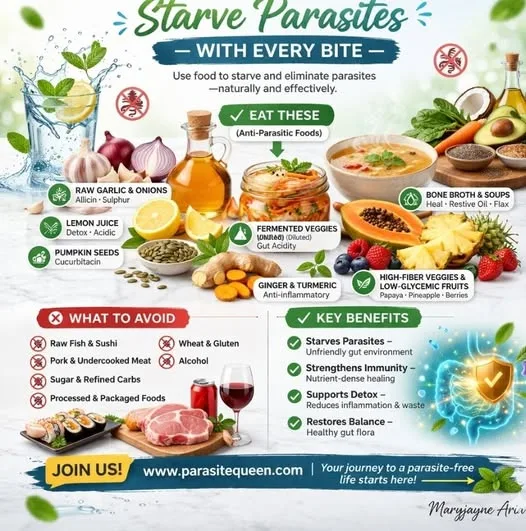
• Garlic: Contains compounds with laboratory antiparasitic activity, but human evidence for treating tissue parasites is limited.
• Ginger: Contains compounds with anti-inflammatory and antioxidant properties.
• Turmeric: Curcumin has anti-inflammatory activity, although it is not an established treatment for tissue parasites.
• Whole foods: Emphasise vegetables, fruit, quality proteins, legumes, nuts, seeds and minimally processed foods.
• Rest: Allows muscle and the immune system time to recover.
• Gentle movement: Helps maintain mobility when medically appropriate.
Supporting the Body During Treatment:
Treating a parasite involves more than killing the organism. The body must also manage inflammation, repair damaged tissue and restore normal physiological function.
• Adequate protein
• Sufficient fluids
• Balanced electrolytes
• Appropriate micronutrient intake
• Adequate sleep
• Rest during acute illness
• Gradual return to physical activity
• Correction of confirmed nutritional deficiencies
• Appropriate monitoring during prolonged treatment
The idea that every worsening symptom represents "detoxification" should be approached cautiously. New or severe symptoms can indicate medication effects, complications or progression of disease and should not automatically be dismissed as a healing reaction.
Why Herbal Treatment Requires Caution
Natural does not automatically mean harmless. Concentrated herbal preparations can interact with prescription medicines and may affect the liver, kidneys, blood pressure or blood clotting.
Combining numerous antiparasitic herbs with prescription medicines can also make it difficult to identify the cause of an adverse reaction.
Muscle Recovery After Infection:
Once the infection has been controlled, muscle recovery may take time.
Inflammation can temporarily reduce strength and exercise tolerance. Prolonged illness can also cause reduced activity and loss of muscle conditioning.
Recovery should therefore be gradual.
Gentle movement can help maintain mobility, followed by progressive strengthening when symptoms and medical status allow.
When Muscle Symptoms Need Urgent Assessment:
• Severe or rapidly increasing weakness
• Difficulty breathing
• Chest pain
• Difficulty swallowing
• Severe swelling
• Dark or cola-coloured urine
• Significant neurological symptoms
• Severe fever
• Confusion
• Rapidly worsening muscle pain
These symptoms can indicate serious muscle injury or systemic complications and should not simply be attributed to parasites or "die-off."
The Bigger Picture:
Parasites can affect muscle, but they do so in very different ways.
Trichinella larvae establish themselves inside skeletal muscle cells. Taenia solium can form cysts within muscle. Toxoplasma can persist as microscopic tissue cysts. Sarcocystis can produce muscular infection and inflammation, while Echinococcus can occasionally form hydatid cysts in muscle. Toxocara can migrate through tissues and provoke inflammatory disease.
This diversity matters because treatment depends on identifying the organism, its life stage and where it is located.
There is also an important distinction between an intestinal parasite and a tissue parasite. A medication that works against an intestinal worm does not necessarily eliminate a parasite that has established itself inside muscle or formed a tissue cyst.
Likewise, herbs and nutritional approaches may provide supportive care, but laboratory antiparasitic activity should not be confused with proven clinical eradication of a human tissue infection.
The most useful approach is to combine careful exposure history, appropriate laboratory testing, imaging when indicated, identification of the specific parasite and targeted treatment with nutritional and supportive measures that help the body recover.
Persistent unexplained muscle pain deserves investigation, particularly when it occurs with eosinophilia, fever, elevated muscle enzymes, unusual muscular lumps, relevant food exposure or travel history.
Understanding that parasites can sometimes affect muscle expands the diagnostic picture, but it is equally important not to assume that every unexplained muscle symptom is parasitic.
Feel free to share this post without making any alterations.