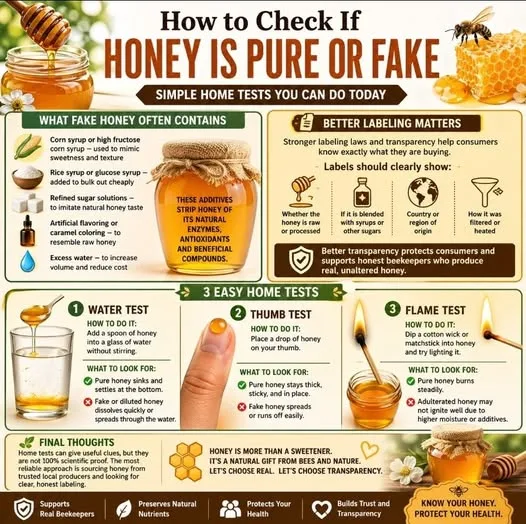
Honey has been treasured for centuries as both a food and a traditional wellness staple. But in today’s market, not all honey is what it claims to be. Many products labeled as “honey” are actually blends of real honey with syrups, sugars, or industrial sweeteners. Knowing how to spot the difference can help you make more informed choices.
Understanding What “Fake Honey” Often Contains
Before looking at home tests, it helps to understand what adulterated honey usually includes.
Some common ingredients found in fake or diluted honey products are:
Corn syrup or high fructose corn syrup used to mimic sweetness and texture
Rice syrup or glucose syrup added to bulk out the product cheaply
Refined sugar solutions to imitate natural honey taste
Artificial flavoring or caramel coloring to resemble raw honey
Excess water to increase volume and reduce production cost
These additions change not only the taste and texture but also the natural enzyme content and beneficial compounds found in real honey. Pure honey contains enzymes, antioxidants, pollen traces, and naturally low moisture levels, while adulterated versions often lose much of this complexity.
This is why clearer and stricter labeling is becoming increasingly important. Terms like “pure honey” are not always tightly regulated in every country, which allows blended products to appear natural even when they are not. Better labeling would ideally include transparency about origin, processing methods, and whether the honey is raw, filtered, or mixed with syrups.
Simple Ways to Check Honey at Home
Water Test:
How to do it: Add a spoon of honey into a glass of water without stirring.
What to look for:
Pure honey sinks and settles at the bottom for a while.
Fake or diluted honey dissolves quickly or spreads through the water.
Thumb Test
How to do it: Place a drop of honey on your thumb.
What to look for:
Pure honey stays thick, sticky, and in place.
Fake honey spreads or runs off easily.
Flame Test
How to do it: Dip a cotton wick or matchstick into honey and try lighting it.
What to look for:
Pure honey burns steadily.
Adulterated honey may not ignite well due to higher moisture or additives.
Why Transparency Matters
Honey is more than just a sweetener. It is a natural product shaped by bees, flowers, and environment. When it is diluted with syrups or altered with additives, it becomes something quite different from what most people expect.
Clearer labeling standards would help consumers understand:
Whether the honey is raw or processed
If it is blended with syrups or other sugars
Its country or region of origin
How it was filtered or heated
Better transparency would not only protect consumers but also support genuine beekeepers who produce real, unaltered honey.
Final Thoughts
While home tests can give useful clues, they are not definitive scientific proof. The most reliable approach is sourcing honey from trusted local producers and looking for clear, honest labeling.
As awareness grows, so does the demand for authenticity. And in something as natural as honey, transparency should be just as important as taste.
Written for information only. The article is not medical advice.
Written by Maryjayne Aria
Author of Immune Health, Terrain & GcMAF