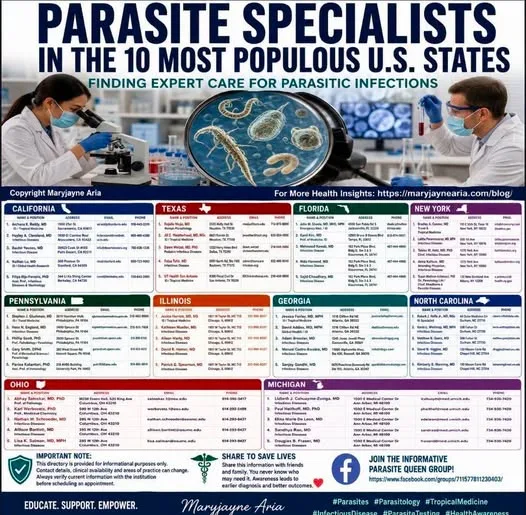
Finding a qualified specialist for a suspected parasitic infection can be surprisingly difficult. Parasitology overlaps several medical fields, including infectious diseases, tropical medicine, laboratory medicine, pathology and public health. The following directory highlights physicians and researchers with documented expertise in human parasitic diseases across the 10 most populous U.S. states.
CALIFORNIA: California has major academic and infectious-disease centers with expertise in parasitic and tropical diseases, including specialists associated with UC Davis, UCLA, Stanford and UC Berkeley. Examples include:
1. Archana K. Reddy, MD, infectious diseases and tropical/travel medicine;
2. Hayley A. Cleveland, MD, infectious diseases;
3. Bachir Younes, MD, infectious diseases;
4. Nathan Lo, MD, infectious diseases and global health research;
5. Filipa Rijo-Ferreira, PhD, whose research focuses on parasitic diseases.
TEXAS: Texas has some particularly strong parasitology resources.
1. Rojelio Mejia, MD, at Baylor College of Medicine is especially relevant because of his work in human parasitology and molecular parasitology testing.
2. Jill E. Weatherhead, MD, MSc, cTropMed, works in infectious and tropical medicine with research involving parasitic infections.
3. Dawn Wetzel, MD, PhD, at UT Southwestern and infectious-disease specialists involved in parasitic disease care at centers throughout Texas.
FLORIDA: Florida has extensive tropical-medicine expertise because of its geographic position and international travel population. Specialists include:
1. John M. Sheele, MD, MHS, MPH, whose research includes human parasites
2. Kami Kim, MD, whose expertise includes malaria and parasitic diseases;
3. Infectious-disease physicians at Florida Infectious Disease Specialists, including Mehmood Nawab, MD, and Nida Hameed, MD.
NEW YORK: New York contains several major infectious-disease and tropical-medicine centers.
1. Bradley A. Connor, MD, specializes in travel and tropical medicine and has extensive experience with parasitic infections.
2. Lalitha Parameswaran, MD, MPH, at NYU Langone treats parasitic disease among other infectious conditions.
3. Memorial Sloan Kettering specialists Tobias M. Hohl, MD, PhD, and Anna Kaltsas, MD,
4. Susan Madison-Antenucci, PhD, at the Wadsworth Center is particularly important from a laboratory perspective because of her leadership in parasitology and bloodborne and parasitic disease testing.
PENNSYLVANIA: Pennsylvania has significant academic parasitology resources, particularly in Philadelphia.
1. Stephen J. Gluckman, MD, is an infectious-disease and travel-medicine specialist whose expertise includes parasitic and tropical diseases.
2. Ross N. England, MD, treats infectious diseases including parasitic infections.
3. Researchers Phillip Scott, PhD,
4. Gary Smith, DPhil, and Parisa Kalantari, PhD, contribute substantial expertise in parasite immunology, epidemiology and human parasitic disease research.
ILLINOIS: The University of Illinois Chicago has important expertise in tropical and parasitic diseases.
1. Jesica Herrick, MD, MS, is an infectious-disease physician with particular experience involving helminths, echinococcosis and neurocysticercosis. Her training at the NIH Laboratory of Parasitic Diseases gives her a particularly strong background in clinical parasitology.
GEORGIA: Georgia has exceptional infectious-disease and tropical-medicine resources through Emory University and other medical centers.
1. Jessica Fairley, MD, MPH, works in infectious and tropical medicine with interests involving neglected tropical diseases and parasitic co-infections.
2. David Addiss, MD, MPH, has extensive experience with neglected tropical diseases and previously worked with the CDC's Division of Parasitic Diseases.
3. Adam Bressler, MD,
4. Manuel Castro-Borobio, MD, are additional infectious-disease physicians with experience involving parasitic infections.
NORTH CAROLINA: North Carolina has strong infectious-disease programs through Duke University and the University of North Carolina.
1. Robert J. Rolfe Jr., MD, MSc, at Duke Health has particular interests in vector-borne and parasitic diseases.
2. UNC's infectious-disease program also provides specialist evaluation and management of parasitic infections.
OHIO: Ohio State University has significant parasite research expertise.
1. Abhay Satoskar, MD, PhD, is a professor of pathology whose research focuses heavily on parasite immunology.
2. Karl Werbovetz, PhD, conducts research involving human parasitic diseases including leishmaniasis, trypanosomiasis and malaria. These academic specialists are particularly valuable for understanding parasite biology, diagnostics and treatment research.
MICHIGAN: Michigan has specialist resources through the University of Michigan.
1. Lizbeth J. Cahuayme-Zuniga, MD, is an infectious-disease specialist whose work includes parasitic infections, tropical medicine and infections associated with transplantation.
CLINICAL SPECIALIST OR PARASITOLOGY RESEARCHER? This distinction matters. A physician specializing in infectious diseases or tropical medicine is generally the appropriate starting point for someone who needs clinical evaluation, diagnosis and treatment. A parasitologist, microbiologist or laboratory scientist may instead specialize in parasite identification, laboratory testing, parasite biology or research. Some specialists combine both areas.
WHAT CAN A PARASITE SPECIALIST INVESTIGATE? Depending on the patient's history and symptoms, evaluation may involve intestinal protozoa, helminths, tissue parasites, blood parasites, vector-borne parasites, tropical infections and parasites acquired through food, water, animals, soil or travel. Testing may include appropriately selected stool examinations, antigen or molecular testing, blood tests, serology, microscopy, imaging or tissue examination. The correct test depends heavily on the suspected organism and where it may be located in the body.
WHY SPECIALIST EVALUATION MATTERS: Parasites have different life cycles, tissue preferences and diagnostic windows. A negative result from one test does not necessarily investigate every possible parasite. Conversely, symptoms alone cannot establish that a parasite is responsible. A specialist can use exposure history, travel history, symptoms, laboratory findings and appropriate diagnostic testing to determine what should actually be investigated.
A USEFUL STARTING POINT: When contacting a specialist, provide a concise history including countries visited or lived in, freshwater or soil exposure, animal exposure, food and water exposure, previous parasite diagnoses, previous antiparasitic treatment, laboratory results and the main symptoms. Bringing copies of previous laboratory reports can save considerable time.
This directory should be treated as a starting point rather than an endorsement of any individual practitioner. Contact details, clinical availability and areas of practice can change, so verify current information directly with the institution before arranging an appointment.
If you are looking for a parasite specialist, save this information and share it with someone who may need it. Awareness can make it easier to find the right medical expertise.