Varicose veins are usually caused by weakened venous valves, allowing blood to flow backward and pool in superficial veins. Age, genetics, pregnancy, prolonged standing or sitting, obesity and previous deep-vein thrombosis are established risk factors.
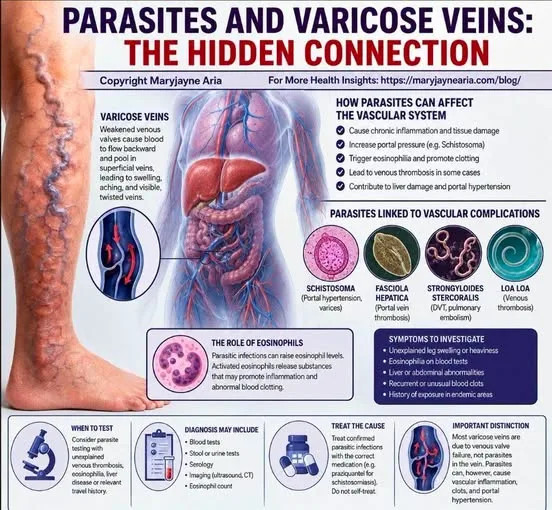
THE PARASITE CONNECTION IS MORE COMPLEX: There is not strong evidence that ordinary intestinal parasites directly cause typical varicose veins. However, certain parasitic infections can affect the vascular system, liver, surrounding tissues and blood-coagulation pathways. These less common mechanisms make parasites a potential consideration when venous problems occur alongside unexplained systemic symptoms, eosinophilia, abdominal disease or relevant travel exposure.
SCHISTOSOMIASIS AND PORTAL PRESSURE: Schistosoma infections provide one of the clearest examples of parasite-related vascular disease. Eggs can become trapped around the liver and intestine, producing chronic inflammation and fibrosis. In heavier infections, this can cause portal hypertension, increasing pressure within the portal venous system and enlarging veins in the abdomen and gastrointestinal tract.
PARASITES AND BLOOD CLOTS: Some parasitic infections have been associated with venous thrombosis, although this is uncommon and should not be confused with ordinary varicose veins. Published cases have described thrombosis associated with Strongyloides, Fasciola and other parasitic infections.
EOSINOPHILIA MAY MATTER: Parasitic infections can stimulate eosinophilia. Activated eosinophils can release substances that promote coagulation and potentially contribute to vascular occlusion. A review of published cases identified an association between parasitic disease, eosinophilia and vascular thrombosis, although the evidence largely consists of rare cases rather than proof that parasites commonly cause venous disease.
FASCIOLA AND VASCULAR COMPLICATIONS: Fasciola hepatica, the liver fluke responsible for fascioliasis, can produce significant hepatic inflammation. Rare reports have documented portal-vein thrombosis and even multisite venous thromboembolism occurring with hepatic fascioliasis. These cases demonstrate that parasite-associated vascular complications can be medically important, even though they are unusual.
STRONGYLOIDES AND THROMBOSIS: Strongyloides stercoralis normally infects the intestine, but severe hyperinfection can become systemic. Rare published cases have reported deep-vein thrombosis and pulmonary embolism during severe infection. This does not mean that Strongyloides causes ordinary spider veins or varicose veins, but it demonstrates another possible relationship between parasitic infection, inflammation and abnormal clotting.
LOA LOA AND VASCULAR INVOLVEMENT: Loa loa filariasis has also been reported in association with venous thrombosis. One published case documented ulnar-vein thrombosis accompanied by eosinophilia and positive filarial testing. Such reports are rare but illustrate that some tissue-invasive parasites can interact directly or indirectly with the vascular system.
WHY LEGS MAY FEEL HEAVY: Venous insufficiency can cause pooling of blood, increased venous pressure, swelling, aching, itching and skin changes. These symptoms are not specific for parasites. However, persistent leg swelling accompanied by unexplained eosinophilia, gastrointestinal or liver symptoms, recurrent thrombosis or a history of exposure to parasite-endemic environments deserves proper medical investigation rather than being automatically attributed to simple varicose veins.
THE IMPORTANT DISTINCTION: A visible, twisted superficial vein is usually a mechanical venous-valve problem, not evidence of parasites living inside the vein. Parasites can, however, cause certain forms of vascular inflammation, tissue damage, portal hypertension or thrombosis. Therefore, the scientifically accurate connection is not "parasites cause varicose veins," but rather that some parasitic diseases can produce vascular abnormalities that may sometimes resemble or complicate venous disease.
WHEN INVESTIGATION MAKES SENSE: Unexplained venous thrombosis, marked eosinophilia, persistent abdominal or liver abnormalities, unusual vascular symptoms, or travel involving freshwater exposure or parasite-endemic regions can justify targeted testing. Depending on the suspected organism, investigation may include blood tests, stool or urine testing, serology and appropriate imaging. Schistosomiasis, for example, can require stool or urine examination and blood testing, with treatment depending on the species and clinical situation.
TREAT THE CAUSE, NOT THE ASSUMPTION: Established varicose veins should be assessed as venous disease, while suspected parasitic infection requires organism-specific diagnosis and treatment. Schistosomiasis, for example, is treated with praziquantel, while other parasites require completely different medicines. Treating parasites without evidence of infection is not a substitute for vascular assessment.
THE BIGGER PICTURE: The connection between parasites and the vascular system is scientifically real, but it is much narrower than social-media claims often suggest. Parasites can influence inflammation, eosinophilia, coagulation, hepatic circulation and, in rare circumstances, the veins themselves. Understanding these mechanisms helps distinguish genuine parasite-associated vascular disease from the far more common causes of ordinary varicose veins.
If you found this information useful, please share without making any changes, to increase awareness and help others recognise the less obvious effects that parasitic infections can sometimes have on the body.