Every week, people send photographs or descriptions of things they have found on tissue paper after using the bathroom. Many are understandably alarmed and immediately assume they are looking at parasites. Sometimes they are correct, but very often the explanation is something far less dramatic. Understanding the difference between actual parasites and common look alike materials can prevent unnecessary fear while still encouraging people to remain aware of their health.
Parasites are real and they do affect millions of people around the world. However, the human digestive system also produces many substances that can resemble worms or other organisms when seen on toilet tissue. Mucus, undigested food fibers, intestinal lining, yeast strands, and even fragments of toilet paper can easily be mistaken for parasites.
Education is important because misidentification happens frequently.
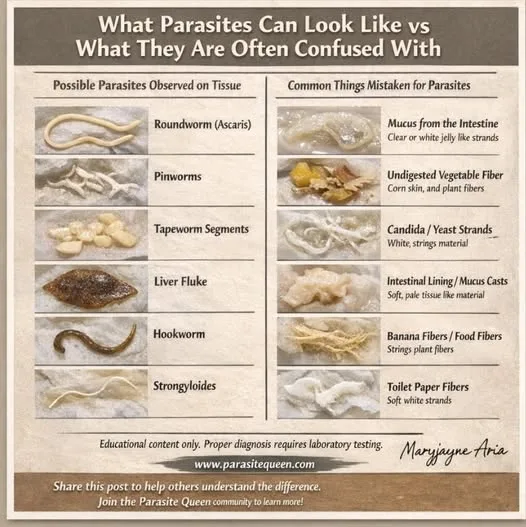
Below are examples of parasites that can sometimes be visible to the human eye, followed by common materials that are often confused with them.
Parasites That May Be Seen By the Naked eye:
Roundworm (Ascaris)
Roundworms are long, pale worms that can resemble cooked spaghetti. In heavy infections they may be visible in stool.
Pinworms
Pinworms are tiny white thread like worms that are often noticed around the anal area, particularly at night.
Tapeworm Segments
Tapeworms shed small segments called proglottids. These can look like grains of rice or cucumber seeds and may move when freshly passed.
Liver Flukes
These flat leaf shaped parasites live primarily in the liver or bile ducts. They are rarely seen in stool but can appear in certain cases.
Hookworms
Hookworms are small curved worms that attach to the intestinal wall and feed on blood. They are rarely visible but may occasionally be passed.
Strongyloides
Strongyloides are extremely thin thread like worms. Their larvae are microscopic but advanced infections can sometimes produce visible material.
Things Often Mistaken for Parasites
Intestinal Mucus
The digestive tract naturally produces mucus to protect the intestinal lining. When passed, it can appear as clear or white strands that resemble worms.
Undigested Vegetable Fiber
Foods such as corn, tomatoes, peppers, and leafy vegetables contain fibers that are difficult to digest. These fibers can emerge looking like stringy worm like shapes.
Yeast or Candida Strands
Overgrowth of yeast can create white stringy biofilm like material that may be mistaken for parasites.
Intestinal Lining or Mucus Casts
Occasionally the body sheds pieces of intestinal lining or mucus casts. These soft pale materials can look unusual and cause concern.
Banana or Plant Fibers
Many fruits contain long fibrous strands that survive digestion and appear worm like when seen on tissue.
Toilet Paper Fibers
Wet toilet paper can separate into thin strands that closely resemble small worms.
Why Proper Testing Matters
The only reliable way to confirm a parasite infection is through proper laboratory testing. Stool tests, microscopy, and specialized diagnostics allow trained professionals to identify parasite eggs, larvae, or DNA. Visual inspection alone is rarely sufficient.
This does not mean people should ignore symptoms. Digestive discomfort, fatigue, unexplained nutrient deficiencies, and other health issues can sometimes be associated with parasitic infections. Awareness and education are important, but so is careful evaluation.
Learning the difference between parasites and harmless materials helps people respond with knowledge rather than panic.
Knowledge empowers people to make better choices.
Written by Maryjayne Aria , author of the book Immune Health, Terrain & GcMAF.
DO YOU HAVE A QUESTION REGARDING PARASITES? Join us for more parasite insites
FEEL FREE TO FOLLOW ME
SHARE FROM MY PERSONAL PAGE
SHARE THIS POST