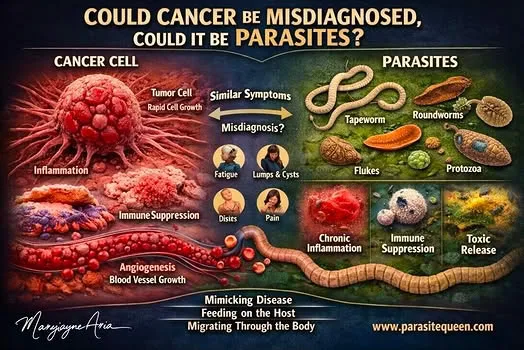
Throughout medical history, the boundaries between cancer, chronic infection, inflammation, cyst formation, and parasitic activity have not always been clear. Early medical texts often described growths assumed to be malignant that were later identified as parasitic cysts or inflammatory granulomas. This does not equate cancer with parasites, but it raises an important question. How often do biological processes mirror one another so closely that current technologies struggle to distinguish them?
As imaging and molecular testing advance, this question has gained renewed attention. Terrain based models highlight that internal biology does not always fit clean diagnostic categories. Modern medicine is designed to classify.
What appears malignant is treated as malignant. What appears infectious is treated as infectious. Yet biological reality is often more complex.
1. Blood work illustrates limitations. Blood markers associated with cancer are also influenced by chronic infection, parasitic burden, inflammation, or metabolic stress.
Elevated inflammatory markers, enzyme changes, anemia, altered white cell counts, or metabolic disruption DO NOT point exclusively to malignancy. Long standing immune strain or encapsulated infections can produce similar laboratory patterns.
For this reason, blood tests cannot reliably distinguish cancer from chronic infection or parasitic involvement.
Numerous documented cases show blood profiles suggestive of malignancy later traced to parasitic cysts, fungal infections, or inflammatory granulomas. These are not failures of medicine, but reflections of overlapping biological signals.
2. Imaging introduces further complexity. Ultrasound, CT, MRI, and PET scans visualize structure, not intent. Many parasites form cysts, nodules, calcifications, or masses that resemble tumors. Hydatid cysts, encapsulated worms, fungal granulomas, and chronic abscesses appear indistinguishable from cancer on scans alone.
Radiology literature documents repeated examples. Parasitic liver cysts mistaken for tumors. Lung lesions from migration interpreted as metastases. Brain cysts initially classified as malignant. These similarities arise because imaging relies on pattern recognition, and different biological processes can create identical visual patterns.
Contrast enhancement may reflect inflammation rather than cancer. Irregular borders may result from immune containment, not uncontrolled cell growth. From a terrain perspective, these structures represent the body’s attempt to isolate perceived threats within its internal environment.
3. Biopsy is often considered the diagnostic gold standard, yet it too has limits. Tissue samples represent only a small portion of a larger lesion. Inflammatory reactions, fibrosis, necrosis, calcification, and granuloma formation can complicate interpretation. Parasitic structures provoke cellular changes that appear atypical when viewed.
While pathology remains essential, documented cases show initial malignant interpretations later revised as infectious or parasitic. These examples highlight biological complexity rather than diagnostic failure. Tissue patterns reflect immune response, and similar responses can arise from different causes.
This leads to a broader question. How should diagnosis evolve when biological overlap limits certainty? Some researchers argue for expanded investigation before irreversible treatment, especially when symptoms or exposure history suggest chronic infection or parasitic burden.
Terrain based science adds another dimension by emphasizing internal conditions such as oxygenation, mineral balance, microbial ecology, pH, and nutrient availability. When terrain becomes hypoxic, acidic, congested, or depleted, multiple disease processes may emerge that look alike diagnostically. Lesions may reflect ecological imbalance rather than isolated disease.
This perspective does not reject chemotherapy, radiation, or biopsy. It asks whether diagnostic precision should evolve to match biological complexity, especially when uncertainty remains.
Over time working in systems biology, a repeating pattern emerges. Hypoxia, inflammation, fibrosis, angiogenesis, and metabolic rewiring appear in chronic infection as well as cancer. The body uses a limited but effective containment toolkit. It walls off what it cannot neutralize. It builds fibrotic barriers. It alters metabolism. The structure may appear identical even when the cause is not.
From this perspective, the medical system is encouraged to pause when ambiguity exists. The question becomes whether a lesion truly represents malignancy, or whether it reflects a terrain that encourages misleading patterns. Some researchers propose that targeted ecological support or further investigation may be appropriate before irreversible intervention in select cases.
This discussion also intersects with interest in repurposed antiparasitic medications such as albendazole, fenbendazole, mebendazole, and ivermectin. Laboratory studies suggest these agents affect cellular structure, metabolism, and oxidative pathways. This does not prove they treat cancer, nor does it imply cancer is parasitic. It indicates overlapping biological mechanisms that merit further research.
Clinical anecdotes alone are insufficient, but observed patterns matter. They suggest that some lesions interpreted as cancer may involve chronic infection, inflammation, or parasitic cysts that closely resemble tumors on imaging.
Ultimately, the core message is caution. When diagnostic pathways yield uncertainty, deeper exploration may be warranted before invasive or irreversible treatment. This is not opposition to conventional medicine. It is a call for precision. A body presenting multiple possible explanations deserves clarity before permanent decisions are made.
For more parasite insights see parasitequeen.com Also join our friendly informative facebook group
https://www.facebook.com/share/16pgwwN4ka/
Written and illustrated by Maryjayne Aria