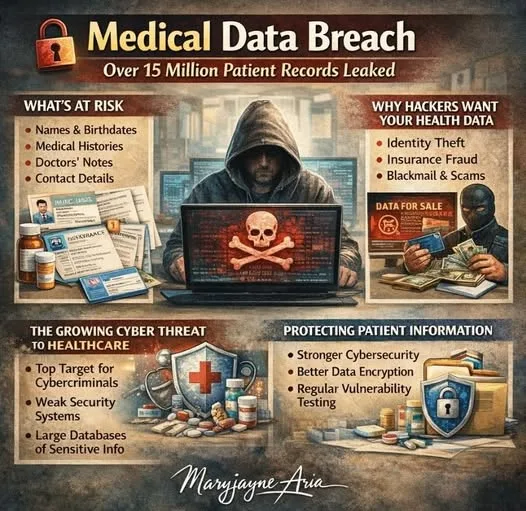
A massive health data breach has exposed the private medical information of more than 15 million patients, sending shockwaves through the healthcare and cybersecurity communities. The incident has raised serious concerns about how medical records are stored, protected, and shared in an increasingly digital healthcare system.
For millions of people, the information they trusted doctors to keep confidential may now be circulating in criminal networks.
What Happened
The breach occurred after hackers infiltrated a medical software platform used by doctors and clinics to manage patient records.
These systems are designed to store and organize highly sensitive information including:
• Patient names and contact details
• Dates of birth
• Medical histories
• Prescriptions and treatments
• Insurance information
• Doctor consultation notes
Once attackers gained access to the system, they were able to extract a massive database containing the information of millions of patients.
Early estimates suggest that over 15 million records were exposed, making it one of the largest medical data leaks reported in recent years.
Why Medical Data Is So Valuable
Unlike stolen credit card numbers, which can be quickly cancelled, medical records contain permanent personal information.
This makes them extremely valuable to cyber criminals.
Stolen health data can be used for:
• Identity theft
• Insurance fraud
• Medical billing scams
• Blackmail and extortion
• Creation of fake medical identities
Some cybersecurity analysts say a single complete medical record can sell for far more than a stolen credit card on underground criminal markets.
The Growing Threat to Digital Healthcare
Healthcare systems around the world have rapidly transitioned to electronic medical records and digital platforms.
While these systems make healthcare more efficient, they also create large centralized databases filled with sensitive information.
If security is weak or outdated, a single breach can expose millions of patients at once.
Hospitals and clinics have increasingly become attractive targets for hackers because many healthcare systems still rely on older software and complex networks that are difficult to secure.
In some cases, cybersecurity has not kept pace with the speed of digital healthcare expansion.
What Information Was Exposed
Although investigations are still ongoing, early reports suggest the leaked database included a range of personal information.
This may include:
• Full names
• Contact details
• Dates of birth
• Medical conditions
• Doctor visit notes
• Prescription records
While financial details were not the primary target, the personal information alone can still cause long term risks for those affected.
The Privacy Crisis
Medical privacy has always been one of the most protected areas of personal information.
Patients must feel confident that they can speak openly with their doctors without fear that their personal health details could become public.
When large scale breaches occur, that trust is shaken.
Many patients are now questioning whether their medical information is truly secure in digital systems.
Healthcare providers also face growing pressure to strengthen cybersecurity and protect patient confidentiality.
Investigations and Response
Authorities and cybersecurity experts are currently investigating how the breach occurred.
Key questions include:
• How did hackers gain access to the system
• Were security vulnerabilities ignored or overlooked
• How long attackers had access before the breach was discovered
• Whether the stolen data has already been sold or distributed online
Regulators may impose penalties if investigators determine that the software provider or healthcare organizations failed to properly secure patient information.
A Warning for the Future
Experts warn that this breach is part of a much larger trend.
Healthcare has become one of the most targeted industries for cyberattacks worldwide.
As medical systems become more interconnected through telemedicine, digital prescriptions, and online patient portals, the amount of stored health data continues to grow rapidly.
Without stronger cybersecurity protections, similar breaches could become more common.
Protecting Patient Data
To prevent future incidents, cybersecurity specialists recommend stronger safeguards such as:
• Advanced encryption of patient records
• Multi factor authentication for healthcare systems
• Continuous security monitoring
• Regular vulnerability testing
• Faster breach detection and reporting
Protecting medical data is not just a technical issue.
It is about preserving patient trust and personal dignity.
The Bigger Question
This breach raises a difficult question for the future of healthcare.
As medicine becomes more digital, can healthcare systems keep sensitive patient information safe from cyber criminals?
The answer may determine how much people trust the digital healthcare systems that are rapidly becoming part of everyday medical care.
Written by Maryjayne Aria, author of the book Immune Health, Terrain & GcMAF.