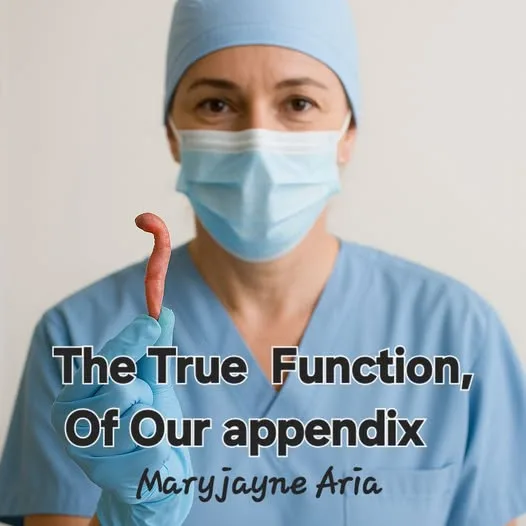
For decades the appendix was dismissed as a useless evolutionary leftover, a small worm shaped pouch in the lower right abdomen with no known function, ripe for removal and little mourned. But recent research is challenging that narrative and suggesting the appendix may quietly play a role in immune and gut health systems.
Situated off the cecum, the first part of the large intestine, the appendix contains lymphoid tissue and is home to a surprisingly diverse microbial community. Studies report the appendix houses biofilms and bacteria that may serve as a “safe house” for beneficial gut microbes, especially after illness, antibiotic use or gut disturbances.
One review puts it this way: the appendix might act as a reservoir of friendly bacteria, repopulating the colon after disturbances.
Another study found that people who had their appendix removed showed measurable changes in gut microbiome composition, including lower diversity and shifts in key bacterial and fungal genera, compared with those who still had theirs.
So yes, the phrase “just a vestigial organ” is looking more outdated. The new view: a small but meaningful player in the body’s microbial and immune ecosystem.
The Removal Factory: How Often the Appendix Gets Axed:
Here is where the sensational side kicks in. Removal of the appendix, known as appendectomy, is an incredibly common surgery in the United States.
One recent trustworthy source says more than 300,000 appendectomies annually in the United States.
Another source reports around 250,000 per year.
For children alone it is about 80,000 appendectomies per year in the United States.
So broadly, hundreds of thousands of people each year have their appendix removed, sometimes in emergencies because of acute inflammation or risk of rupture, and sometimes more prophylactically or incidentally. In past decades, surgeons often removed the appendix during other abdominal surgeries to “prevent future appendicitis.” Older data showed many incidental appendectomies. One report said between 1970 and 1984 the rate of incidental appendectomy was relatively high.
The takeaway: this little organ gets removed a lot, often before we fully understood what its role might be.
Why Does the Appendix Go Bad?
We often assume appendicitis strikes out of nowhere, but it usually begins when something blocks the small opening inside the appendix. That blockage might come from hardened stool, thick mucus, swollen lymph tissue after infection, or even parasites. Once sealed, bacteria multiply rapidly, pressure builds, and inflammation can set in fast.
Diet may play an indirect role. Populations eating high-fiber, plant-rich diets tend to have lower rates of appendicitis. Fiber keeps digestion moving and reduces the chance of blockage. In contrast, diets heavy in processed foods and low in nutrients may add strain. Hydration, bowel habits, and overall microbiome health also seem to matter.
Still, we are still learning. Researchers have not yet pinpointed exactly why the appendix goes bad in some people and not others. It may involve a mix of immune response, microbial imbalance, and genetics. There is much more to learn about this small but surprisingly complex organ.
What This Means and Why We Should Care:
1. Rethinking risk versus benefit. Because we are now learning that the appendix may support gut microbiome health, we might want to ask: under what circumstances is its removal still clearly justified? Emergency appendicitis remains a clear indication. But the “just in case” removal becomes more questionable if the organ does provide backup support for beneficial microbes.
2. Implications for gut health and immunity. If the appendix is a microbial safe house, removing it might change how someone’s gut recovers after illness, antibiotics or diarrhea. Some studies show measurable shifts in microbial diversity among appendectomy patients. That does not prove catastrophic harm, as many people live fine without an appendix, but it suggests there may be subtle consequences.
3. Medical practice and trends. Given the high number of surgeries each year, any change in how we think about the appendix could influence surgical decision making, patient counselling and post operative monitoring. For instance, should surgeons discuss potential longer term gut consequences when removing an appendix that is not badly inflamed?
4. The body matters even in small parts. The fact that an organ long dismissed now has a plausible role reminds us that in biology, things that look unimportant may hide functions we have only recently discovered. That is a neat reminder that small and overlooked parts may have value too.
A Word of Caution:
Even though there is growing evidence of function, we are not at the point of saying “Never remove your appendix.” The evidence is still emerging. The appendix’s role is likely modest, a support role rather than a major organ like the liver or heart. Many people do fine without one. The research also has limitations such as small sample sizes and observational designs.
One article notes: “The importance of these findings, or their meaning in the context of human physiology or evolution, is unclear.”
So this is interesting science, worth integrating into how we think and what we do, but not yet a complete revolution.
Bottom Line:
The appendix is no longer just a useless leftover. It appears to be involved in microbial backup and immune system support. Meanwhile, it is removed hundreds of thousands of times annually in the United States. The fact we are removing it so often while still discovering what it may do gives a little jolt of humility.
For your work, given your focus on parasites, gut health and broader systems, this organ is a good example of how sometimes the overlooked piece matters.
For more health insights,join our growing community group https://www.facebook.com/groups/agooddoctor/
Written and illiterated by Maryjayne Aria