Written by Maryjayne Aria author of Immume Health, Terrain and GcMaf
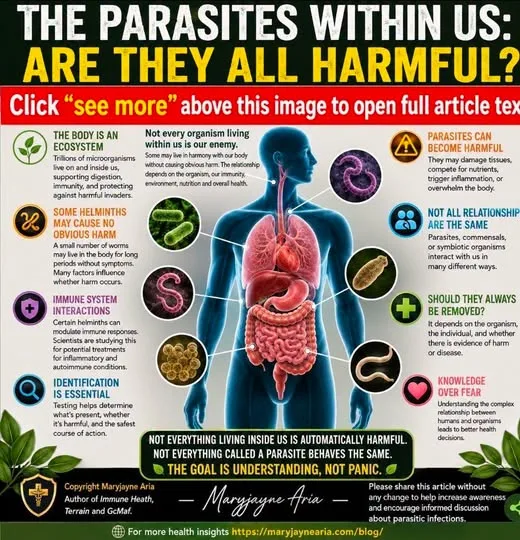
NOT EVERY ORGANISM LIVING WITHIN US IS OUR ENEMY: The word "parasite" often creates an immediate image of disease, destruction and something that must be eliminated. However, the biological relationship between humans and the organisms that live within and around us is far more complex. Not every organism traditionally described as parasitic causes noticeable harm, and some organisms may exist within a host for long periods without producing obvious symptoms or disease.
THE HUMAN BODY AS AN ECOSYSTEM: Humans are complex ecosystems containing bacteria, fungi, viruses and other organisms. Trillions of microorganisms live on the skin, in the mouth, throughout the digestive system and in other areas of the body.
Many of these organisms contribute to normal biological processes, including digestion, nutrient metabolism, immune development and protection against colonisation by potentially harmful organisms. Although bacteria are not parasites, the same ecological principle is important when discussing larger organisms. The presence of another organism does not automatically mean that disease is occurring.
CAN SOME HELMINTHS LIVE WITHOUT CAUSING OBVIOUS HARM?: In certain parts of the world, some helminths, commonly known as parasitic worms, can persist in humans with few or no noticeable symptoms.
This does not necessarily mean they are beneficial or completely harmless.
The effects of an organism depend on many factors, including:
• The species involved
• The number of organisms present
• The location within the body
• The duration of infection
• The individual's immune response
• Nutritional status
• Age and general health
• Other infections or medical conditions
A small burden of an organism may produce no obvious symptoms, while a larger burden of the same organism may cause significant disease.
This is one reason why the absence of symptoms does not always tell us whether an organism is present or whether it may eventually affect health.
THE INTERESTING FIELD OF HELMINTHS AND IMMUNE REGULATION: Scientists have been studying how certain helminths interact with the immune system. Some parasitic worms have evolved sophisticated mechanisms that reduce or modify immune responses, helping them survive inside the host.
This immune modulation has attracted scientific interest because excessive or poorly regulated inflammation is involved in many diseases. Researchers are investigating whether molecules produced by helminths could one day contribute to new treatments for inflammatory or immune-related conditions. However, this research must not be confused with recommending deliberate infection. A naturally occurring infection can have unpredictable consequences.
Even species that appear relatively well tolerated in one person may cause complications in another. The important scientific question is not whether parasites are "good" or "bad" in absolute terms. It is how specific organisms interact with specific hosts under specific conditions.
WHEN PARASITISM BECOMES HARMFUL: Parasites can become harmful when they damage tissues, compete for nutrients, interfere with organ function, trigger inflammation or reproduce beyond what the body can tolerate.
Some infections remain relatively silent for long periods before symptoms appear.
Others can cause immediate illness.
This is why it is scientifically inaccurate to say that all parasites cause immediate disease, but it is equally inaccurate to assume that a parasite causing no current symptoms can never become harmful.
Biology rarely operates in simple categories.
COMMENSALS, SYMBIONTS AND PARASITES: It is useful to understand the difference between these biological relationships.
A commensal organism benefits while causing little or no measurable effect on the host.
A mutualistic organism may provide benefits to both itself and the host.
A parasite benefits at the expense of the host.
In reality, these categories are not always fixed. The same organism may have different effects depending on circumstances.
An organism that causes little apparent harm in one person may contribute to disease in another. Changes in immunity, nutrition, microbiome balance or other environmental factors may influence this relationship.
This highlights the importance of the host environment, sometimes described as the biological terrain.
DOES A PARASITE ALWAYS NEED TO BE REMOVED?: The answer depends on the organism, the individual's health and whether there is evidence of infection or disease.
A confirmed pathogenic parasite should be appropriately evaluated rather than ignored simply because symptoms are absent.
At the same time, indiscriminate attempts to eliminate every organism from the body can also be misguided. The human body contains a complex ecosystem, and interventions may alter microbial balance.
Testing and identification are therefore important.
Rather than assuming that every symptom is caused by parasites, or assuming that parasites can never be involved, a more scientific approach is to investigate.
THE IMPORTANCE OF IDENTIFICATION: Different parasites require different approaches.
There is no single parasite protocol that is appropriate for every organism, every person or every situation.
Testing may involve stool analysis, antigen testing, molecular testing, blood tests, microscopy or other methods depending on the suspected organism.
Identification helps answer important questions:
• Is an organism actually present?
• Which species is involved?
• Is it known to cause disease?
• Is there evidence of tissue damage or inflammation?
• Is treatment necessary?
• What is the safest and most appropriate approach?
Guessing can lead to unnecessary treatment or missed diagnoses.
WHAT WE CAN LEARN FROM ORGANISMS THAT LIVE WITHIN US: The growing study of the microbiome and host-organism interactions is teaching us an important lesson.
Humans do not exist biologically in isolation. We live alongside enormous communities of microscopic life, and in some environments, humans may also carry larger organisms for extended periods without obvious illness.
This does not mean that parasites should be deliberately acquired or ignored.
It means that science should avoid oversimplification.
Not everything living inside us is automatically harmful.
Not everything traditionally labelled a parasite behaves in exactly the same way.
And not every biological interaction can be understood using a simple "good" or "bad" label.
A BALANCED PERSPECTIVE: Parasites are capable of causing serious disease, and parasitic infections deserve proper identification and appropriate medical attention. At the same time, the relationship between humans and other living organisms is extraordinarily complex. Some organisms may persist without obvious symptoms, while others may influence immune activity in ways scientists are still working to understand.
The future of parasite research may therefore involve more than simply asking how to destroy an organism. It may also involve understanding how organisms survive, communicate with the immune system, influence inflammation and interact with the wider ecosystem of the human body.
Knowledge allows us to move away from fear and towards informed investigation.
The goal should not be panic.
The goal should be understanding.
Please share this information without making any changes to help increase awareness of the importance of proper diagnosis for suspected parasitic infections.
Share:
Maryjayne Aria
Independent researcher, author, and educator specialising in GcMAF,
macrophage activation, immune terrain science, and parasite education.
Author of Immune Health, Terrain & GcMAF.