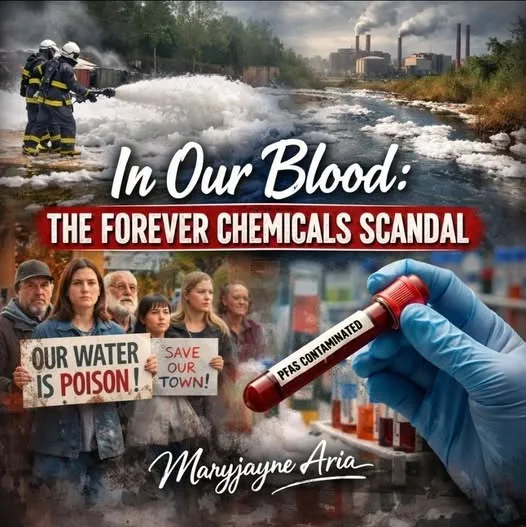
The review of In Our Blood: The Forever Chemicals Scandal captures something deeper than a documentary. It reflects a lived reality that many people are only just beginning to understand. This is not a distant environmental issue. It is personal. It is biological. It is already inside the body.
The phrase “no one should have to live like this” is not dramatic language. It is a quiet acknowledgment of what happens when exposure becomes unavoidable and invisible at the same time.
A story written in the body
The documentary focuses on communities where exposure to PFAS, often referred to as “forever chemicals,” has become part of daily life. These substances are not easily broken down. Once they enter the environment, they remain. Once they enter the human body, they accumulate.
What makes this scandal different is that it is not about a single event or accident. It is about decades of slow exposure. Drinking water, soil, air, and food chains all become part of the pathway.
Blood testing has revealed levels far beyond what would be considered safe. Yet for many, there was no warning, no consent, and no clear way to avoid it.
The human cost behind the science
The documentary moves beyond data and into lived experience.
Families speak about illness that does not have a simple explanation.
Communities describe a shared pattern of disease.
Parents carry the weight of uncertainty, questioning what has already been passed on to their children.
This is where the emotional weight of the review becomes clear. The issue is not only toxicity. It is the loss of trust.
Trust in water.
Trust in food.
Trust in systems that were meant to protect.
A system that allowed it to happen
What emerges is not just a chemical problem, but a regulatory one.
PFAS compounds were used widely in:
firefighting foams
industrial processes
non-stick and stain-resistant products
For years, concerns were raised. Yet production and use continued.
The documentary highlights a familiar pattern:
early warning signs
delayed response
widespread exposure
late acknowledgment
By the time action is taken, the chemicals are already embedded in ecosystems and human biology.
Living with what cannot be removed
One of the most difficult aspects is that there is no simple solution.
PFAS are persistent.
They do not break down easily.
They circulate within the body over time.
So the question shifts from prevention to management.
How do people live knowing that exposure has already occurred?
How do communities rebuild safety when the environment itself has been altered?
This is where the statement “no one should have to live like this” becomes a reflection of ongoing reality, not just past failure.
This documentary is not only about one town or one country. It represents a global issue.
PFAS contamination has been identified across continents.
Water systems, soil, and food chains are interconnected.
What happens in one place rarely stays there.
It challenges a broader assumption that modern systems always move faster than harm. In this case, harm moved quietly and consistently, while awareness lagged behind.
Final thoughts
In Our Blood: The Forever Chemicals Scandal is not just exposing contamination. It is exposing a way of thinking that allowed it.
It asks difficult questions:
How much exposure is acceptable?
Who decides that threshold?
And what happens when that decision is wrong?
At its core, this is a story about responsibility and consequence.
And perhaps most importantly, it is a reminder that health is not only something we manage individually. It is shaped by the environment we are placed into, often without choice.
No one should have to live like this.
Written by Maryjayne Aria , author of the book Immune Health, Terrain & GcMAF.